Home › Road, Street, and Municipal Paving
Partner with a reliable crew for road paving in Spokane, WA. We pave subdivision streets, municipal roads, and access routes with properly engineered asphalt sections. From milling and overlays to full-depth construction, our team delivers smooth, long-lasting streets for drivers, cyclists, and pedestrians.
Precision Asphalt Spokane provides professional road paving throughout Spokane, WA, Washington and the surrounding area. Our licensed, insured crew delivers safe, clean, on-time work with a free estimate before anything begins. Call or request your free quote.
Road and Municipal Paving in Spokane, Done for the Long Haul
Road paving in Spokane is not a one-size-fits-all job. Between freeze-thaw cycles, snow plows, deicer, and heavy logging and farm traffic on some routes, the pavement has to be designed for this specific region. At Precision Asphalt Spokane, we focus on building streets and municipal pavements that hold up to Eastern Washington conditions, not just the first few years after the ribbon cutting, but well into their designed service life.
When we look at a road, street, or city project, we are thinking about how the pavement structure will handle Spokane’s typical temperature swings, how water will get off and away from the surface, and how easy it will be to maintain over time. That means we consider things like subgrade strength, traffic mix (cars versus buses and trucks), and how often the street will see snow removal equipment.
Our goal is to give public agencies, HOAs, industrial parks, and private road owners clear information up front. You will know what is being built under the blacktop, why certain materials are chosen, and what kind of performance to expect over 10 to 20 years. That practical approach is what sets Precision Asphalt Spokane apart from companies that just quote a thickness and a price.
How We Build Roads and Streets That Survive Spokane Winters
A solid road project starts long before any asphalt truck shows up. We begin with a site evaluation and core sampling when needed. If the subgrade soil in your area of Spokane is silty or clay-heavy, we know it will hold water and lose strength when saturated. In those cases we may recommend undercutting and replacing soft soils, adding crushed rock, or using stabilization methods like cement or lime treatment to create a firm base.
Once the subgrade is addressed, we build the aggregate base. For most Spokane streets and access roads, this means a compacted layer of crushed rock with a specific gradation that locks together under compaction. We use rollers sized to the project and run density tests so you are not guessing whether the base is tight enough. The goal is a base that will not rut or pump under traffic when it gets wet.
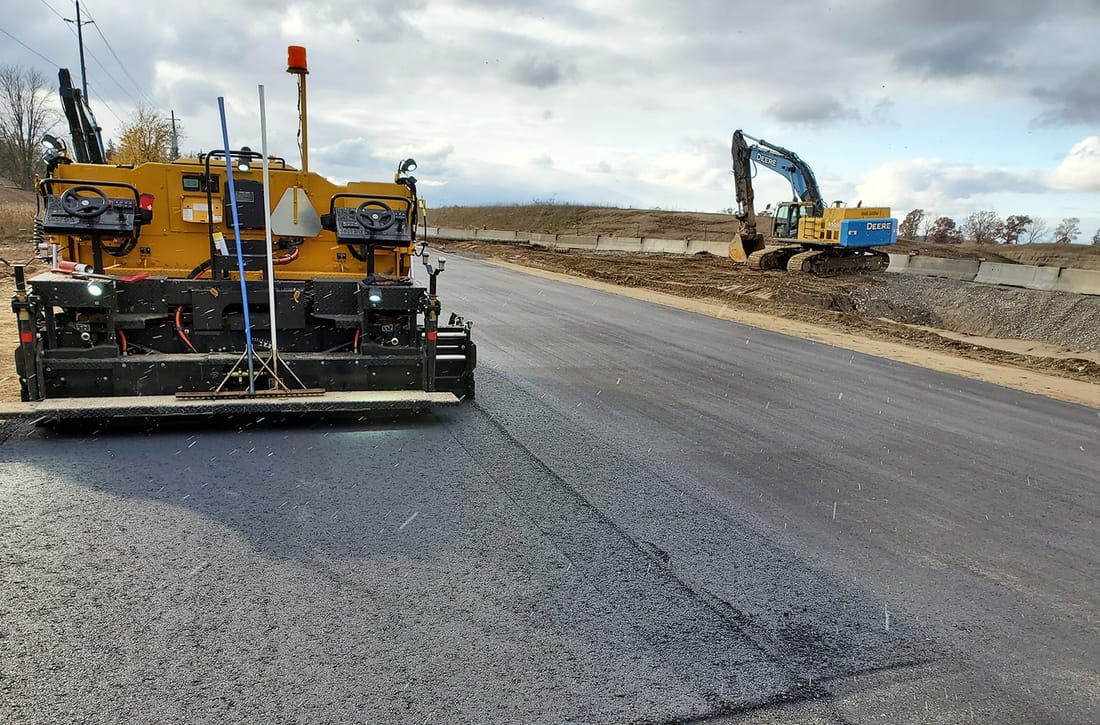
Asphalt placement comes next, usually in multiple lifts. A typical Spokane residential street might get a thicker base course and a slightly thinner surface course, while a bus route or industrial road will get more total asphalt thickness and stronger mix designs with higher quality aggregates. We coordinate with the mix plant to get the correct temperature, because asphalt that arrives too cool or sits in the truck too long will not compact properly and will fail early.
Compaction is where many roads succeed or fail. We follow a rolling pattern that matches the mix, temperature, and layer thickness. We use steel drum and pneumatic rollers to get density without crushing the aggregate. Joints between paving passes are overlapped, cut, and compacted so they do not become early crack lines.
Finally, for municipal and public roads, we coordinate striping, signage, and ADA ramp tie-ins to make sure your project is compliant and safe to open. For private roads and HOA streets, we can provide guidance on posted weight limits and early traffic control so the asphalt has time to cool and gain strength.
Design Choices: Mix Types, Thickness, and Drainage Details
Every bit of road paving in Spokane involves tradeoffs between upfront cost and long-term performance. Precision Asphalt Spokane walks you through those decisions instead of burying them in a spec sheet.
Thickness is one of the biggest drivers of life span. A lightly traveled private lane might be fine with a modest asphalt thickness over a well-built base. A city collector street, school zone, or truck route needs more structure under it. Putting an extra inch of asphalt in the design can add years of life and reduce the need for costly patching later.
Mix type matters too. Spokane sees studded tires, chains, and plows, which are rough on the surface. We often recommend a surface mix with harder aggregate and a balanced binder content. Go too rich on oil and the surface can rut in summer heat; go too lean and it can ravel and crack under winter stress. On steeper hills, we may recommend mix adjustments to improve skid resistance when roads are wet or icy.
Drainage is another key design detail that many people overlook. Water that sits on or under a road in Spokane will freeze, expand, and break the pavement. We design proper crown or cross-slope so water sheds to the gutter, and we match the new pavement to existing catch basins and curb lines so there are no low spots that collect runoff. On rural or private roads with ditches, we look at shoulder design and ditch depth so meltwater and stormwater have somewhere to go.
If you are a city engineer, HOA board, or property manager comparing options, we can provide alternates such as thicker base with slightly thinner asphalt, or a heavier asphalt structure over existing base. We will explain in plain terms what each option means for expected life and maintenance so you can choose what fits your budget and risk tolerance.
Costs, Scheduling, and What Affects Your Road Paving Budget
Road paving costs in Spokane are driven by more than just the price per ton of asphalt. The condition of the existing road, availability of access, traffic control needs, and project timing all play a role. Precision Asphalt Spokane provides itemized proposals so you see where your money is going.
If an existing road is alligatored, heavily cracked, or has visible base failures, a simple overlay is usually a bad idea. You may save in year one but pay much more over the next five years. In those cases we talk about milling off the failing asphalt, repairing weak base areas, and then placing new lifts. Milling depth and patch quantities are some of the biggest cost variables, which is why a good site walk and sometimes test cuts are important before you set a budget.
Traffic control can also be a meaningful line item. A short private road with minimal traffic might only need basic cones and flagging. A city arterial, school zone, or intersection near a hospital may require certified flaggers, detailed traffic control plans, and off-peak or night work. That affects crew size, shift length, and overall cost.
Timing matters in Spokane. The best paving window is typically late April through October, when daytime temperatures allow proper compaction and overnight lows are not dropping too far into the 30s. Cold weather paving can lead to poor density, which shortens pavement life. For critical municipal projects that must happen in shoulder seasons, we plan shorter haul distances, thinner lifts, and more compaction equipment to compensate for cooling.
We also discuss long-term maintenance up front. For example, planning a chip seal or fog seal at the right year can stretch the life of the pavement by several seasons. Knowing this when you are setting a multi-year street budget helps you avoid surprises and keeps your road network in better overall condition.
Common Spokane Road Problems and How We Address Them
Road and street pavements in Spokane tend to fail in predictable ways. Precision Asphalt Spokane has seen most of them and has practical solutions tailored to our local conditions.
Alligator cracking, which looks like a reptile skin pattern, usually means the structure underneath is failing. Simply sealing over it will not solve the problem. We identify the limits of the weakened area, remove the failed asphalt, rebuild the base if needed, then patch with new hot mix that is properly compacted. On larger networks, we can help prioritize which segments get full reconstruction and which can get by with localized patching and an overlay.
Rutting in wheel paths can be caused by heavy truck traffic, a weak base, or a mix that was too soft. If the problem is shallow and the base is sound, milling and replacing the surface course with a stronger mix may fix it. If rutting goes deeper, the fix often involves base repair and thicker asphalt. We look for clues like pumping or movement under load to decide the right solution.
Cracking from Spokane’s freeze-thaw cycles is common, especially along joints and utility trenches. For minor transverse and longitudinal cracks, we use routing and crack sealing to keep water out. For roads with widespread cracking but a still-solid base, a mill-and-fill overlay can restore ride quality and extend life without a full-depth rebuild.
Drainage-related failures often show up as potholes or settling near the gutter or in low spots that stay wet. We evaluate whether the issue is surface drainage, plugged drains, or water migrating under the pavement. Fixes might include regrading the surface, adjusting structures, or improving base and subgrade drainage.
If you manage streets, a private road system, or a small municipality in or around Spokane, we can walk your network, document conditions, and suggest a phased plan. That way, you are not guessing which roads need immediate attention and which can wait with lower cost maintenance solutions.